If you’ve heard that R410A, R134a and R404A are on the way out and you want the clear Australian picture, this is the article for you.
Australia is in the middle of a planned, legislated reduction in the import of high global warming potential (GWP) refrigerants.
That process is reshaping the refrigerants available for new equipment, putting upward pressure on the price and supply of older gases, and changing what you’ll encounter on the tools over the next decade.
Table of Contents
Key Terms
A category of synthetic greenhouse gases widely used as refrigerants in air conditioning and refrigeration equipment. HFCs do not deplete the ozone layer, but most have a very high global warming potential.
The Australian legislative term for gases including HFCs, HCFCs, PFCs, and sulphur hexafluoride.
A measure of how much heat a gas traps in the atmosphere compared to carbon dioxide over a set period (typically 100 years).
A newer class of refrigerant with very low GWP (typically below 10).
Substances such as CFCs and HCFCs that were phased out under the original Montreal Protocol due to their role in depleting the stratospheric ozone layer. HFCs were introduced as ODS replacements but came with their own climate problem.
What Is the Refrigerant Phase-Down?
HFCs became the dominant refrigerant class in the 1990s and 2000s. They replaced chlorofluorocarbons (CFCs) and hydrochlorofluorocarbons (HCFCs), which were phased out because they depleted the ozone layer.
But they are powerful greenhouse gases. By 2015, synthetic greenhouse gases, primarily HFCs, represented 2.2% of Australia’s total carbon dioxide equivalent (CO2-e) emissions, and that figure was projected to grow.
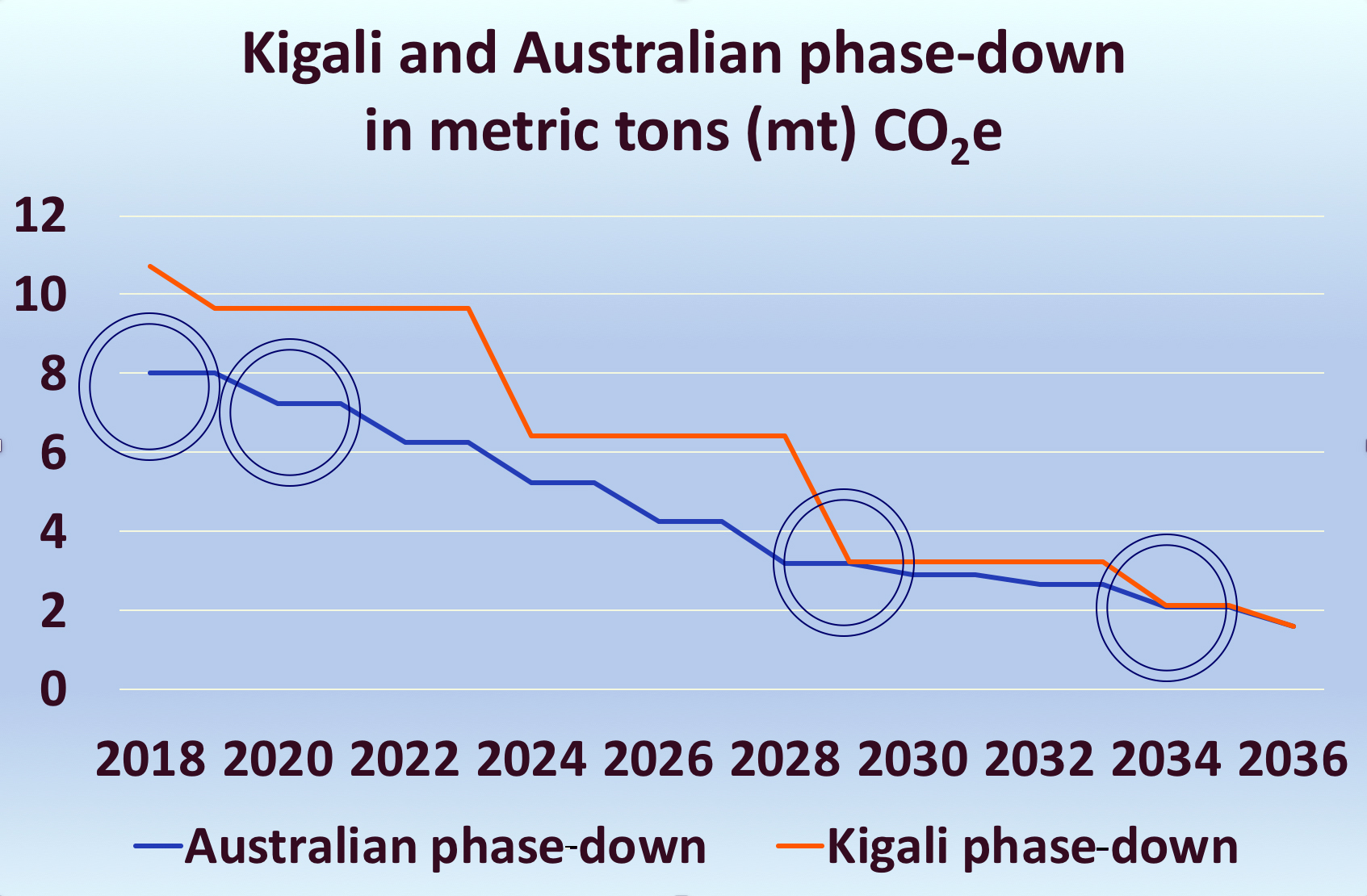
In October 2016, 196 countries signed the Kigali Amendment to the Montreal Protocol, agreeing to phase down global HFC production and consumption by 85% by the late 2040s.
Australia implemented its commitment through a domestic import quota system rather than an outright ban on specific refrigerants.
This means the overall volume of high-GWP HFCs entering the country reduces progressively over time, driving the market toward lower-GWP alternatives, while still allowing technicians to service existing equipment.
The Legislative Basis
Australia’s regulation of refrigerants flows from the Ozone Protection and Synthetic Greenhouse Gas Management Act.
First enacted to give effect to Australia’s Montreal Protocol obligations on ozone-depleting substances, it has since been expanded to cover the broader category of synthetic greenhouse gases, including HFCs.
The HFC phase-down is implemented primarily through a quota system for the import of bulk HFCs. Importers of bulk HFC refrigerant are required to hold a licence and must operate within their allocated quota for each two-year period. The Act also underpins the ARCtick licensing scheme. If you hold a refrigerant handling licence, the requirements for that licence are set under this Act.
The Department of Climate Change, Energy, the Environment and Water administers the Act and publishes the authoritative guidance on quota periods, equipment bans, and compliance requirements.
The Australian Refrigeration Council (ARC) is the industry body responsible for administering the ARCtick licensing scheme.
A Timeline of Australia's Refrigerant Transition
- 1989: Australia implements Montreal Protocol obligations on ozone-depleting substances
- 2016: Kigali Amendment to the Montreal Protocol agreed
- 1 January 2018: Australia’s HFC import quota phase-down begins
- 1 July 2024: Ban on import and manufacture of small single-head split systems, portable, and window/wall AC units using HFC refrigerants with GWP over 750
- August 2024: Qualification requirements for refrigerant handling licences moved to a separate legislative instrument
- 1 July 2025: Ban extended to small multi-head split systems and VRF systems (up to 2.6 kg charge) with HFC refrigerants with GWP over 750
- 1 January 2026: Quota reduced a further 19%
- 2030: Major scheduled step-down; supply of high-GWP refrigerants significantly constrained
- 1 January 2036: Phase-down endpoint
What's Already Changed
The industry has been through a refrigerant transition before. R22 (an HCFC) was phased out under the original Montreal Protocol ozone provisions. Its phase-out is the reference point for how these transitions play out.
The gas remains available for servicing existing equipment for many years after new equipment stops using it, prices rise as supply tightens, and the installed base gradually turns over as equipment reaches end of life. The HFC phase-down follows a similar managed trajectory.
The most significant changes so far are the equipment-specific bans that came into force in 2024 and 2025.
From 1 July 2024, it became illegal to import or manufacture in Australia any small air conditioning equipment using an HFC refrigerant with a GWP above 750, where that equipment has a refrigerant charge of 2.6 kg or less and is intended for stationary comfort cooling or heating.
From 1 July 2025, that ban was extended to outdoor units for small multi-head split systems, including variable refrigerant flow (VRF) systems with a charge of 2.6 kg or less.
That means R410A and R134a can’t be used in new small split systems of any type in Australia. Any new non-ducted split system you install today must be designed for a refrigerant with a GWP of 750 or below.
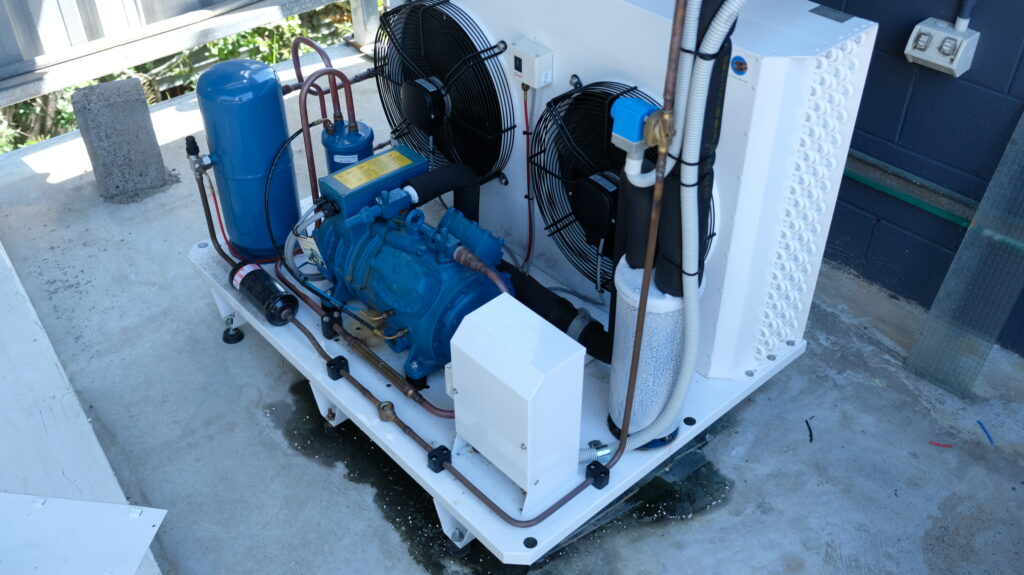
R32 has filled that gap in the residential and light commercial market. R404A and R134a will no longer be able to be used in cold room and freezer room systems with other refrigerants that will need to used as drop ins replacements
| Refrigerant | GWP | Classification | Australian Status (2026) |
|---|---|---|---|
| R410A | 2,088 | A1 (non-flammable) | Banned in new small split AC equipment (July 2024/2025). Still permitted in bulk for servicing existing systems. |
| R404A | 3,922 | A1 (non-flammable) | Not specifically banned by equipment type, but subject to quota pressure. Alternatives (R448A, R449A) increasingly used in commercial refrigeration. |
| R134a | 1,430 | A1 (non-flammable) | Banned in new small split AC equipment (July 2024). Still used in automotive and some commercial refrigeration. |
| R32 | 675 | A2L (mildly flammable) | Permitted. Below the GWP 750 threshold. Now the primary refrigerant in new residential split systems. |
| R290 (propane) | ~3 | A3 (flammable) | Permitted. Low GWP; increasing use in portable units and some commercial refrigeration. Significant flammability considerations. |
| R744 (CO2) | 1 | A1 (non-flammable) | Permitted. Very low GWP; used in commercial refrigeration and emerging in heat pump applications. Higher pressure requirements. |
| R717 (ammonia) | 0 | B2L (flammable/toxic) | Permitted. Zero GWP; traditional industrial refrigerant. Specialist licensing and safety requirements apply. |
What's Changing Now
Equipment bans are one part of the picture, but the quota reduction affects the refrigerants you’re already using in existing systems.
Cold Hard Facts 4 identified a growing gap between HFC supply and demand. By 2024, stockpiles that had helped buffer the transition were largely depleted, and the gap between available import quota and projected demand was widening.
New small split equipment using R410A can no longer be imported, but the installed base of R410A equipment in Australia is enormous, and those systems will need to be serviced for years to come. Technicians will still be able to buy R410A in bulk for that purpose, but as supply tightens relative to demand, prices will start going up.
R404A sits at the high end of the GWP scale among common refrigerants, and it has been heavily used in commercial refrigeration.
Lower-GWP alternatives such as R448A and R449A are available for drop-in use in many existing R404A systems and have GWPs around 1,400. The Cold Hard Facts reports have consistently flagged R404A and R134a as the refrigerants where the transition away from high-GWP products has lagged most.
R32 is now the standard refrigerant for new residential split systems in Australia.
What This Means for Working Installers
If you’re a working RAC technician or installer, here’s what the phase-down means for you.
Any new non-ducted split system you're installing today is almost certainly charged with R32. R32 is classified A2L, mildly flammable, meaning you need to be aware of flammability risks in handling, installation locations, charge sizes, and leak scenarios. This doesn't mean R32 is dangerous in an unmanageable way, but it does require some extra knowledge that working with R410A didn't require.
Hydrocarbons are already appearing in portable AC units. These are genuinely flammable with strict charge limits enforced by design. Technicians encountering these in the field need to understand both the safety requirements and the charge restrictions.
R410A equipment has a service life of 10 to 15 years or more, so equipment installed in 2020 will still be running in 2035. Technicians will be topping up, recovering, and diagnosing R410A systems well into the next decade, but it's worth having an honest conversation with clients whose older R410A equipment needs significant refrigerant work about long-term cost implications.
As R32 and other lower-GWP alternatives become standard in new installations, clients and employers will expect to understand their properties, safety requirements, and service procedures. For those looking at commercial refrigeration or industrial work, CO2 (R744) systems are a growing segment with their own specific knowledge requirements.
Stay Up To Date With Get Skilled
As R32 and other lower-GWP alternatives become standard in new installations, clients and employers will expect you to understand their properties, safety requirements, and service procedures.
If you’re not sure which qualification fits where you are in your career, or what you need to stay competitive as the refrigerant landscape changes, Get Skilled can help you work that out.
Whether you’re starting out, looking to formalise your skills, or thinking about where commercial refrigeration and CO2 work fit into your future, our trainers can point you in the right direction.
Get in touch with the Get Skilled team to talk through your options. We’ll help you identify the qualifications that match your current work, your ARCtick licensing requirements, and where you want to be as the industry transitions.