If you handle refrigerant for a living in Australia, your legal obligations come from one Commonwealth Act, one set of Regulations, and a licensing scheme administered by an industry body. There’s no state-by-state patchwork, and, despite what half the internet will tell you, there’s no such thing as “F-Gas compliance” in Australia.
This article covers what the law actually requires of a working installer or contractor in 2026: who needs a licence, what counts as handling refrigerant, what you have to record, and what happens if you get it wrong.
For the separate question of which refrigerants are being phased down and when, see our article on Australia’s refrigerant phase-down
Table of Contents
What Synthetic Greenhouse Gas Regulation Means in Australia
Australia regulates two things through the same framework: ozone-depleting substances (ODS) and synthetic greenhouse gases (SGGs).
Synthetic greenhouse gases mean hydrofluorocarbons (HFCs), perfluorocarbons (PFCs) and sulphur hexafluoride. You’ll also see the term artificial greenhouse gas (AGS) used in the legislation and in ARC material. For working purposes, AGS and SGG cover the same ground.
The regulation works on two levels, and this distinction is the source of most confusion in the industry:
- Import and supply is controlled through licences and a quota system that limits the total volume of bulk HFCs entering the country. This is what’s driving refrigerant prices and equipment changes.
- Handling is controlled through the ARCtick licensing scheme. This is what applies to you personally, on the tools, every day.
The phase-down changes what you’ll be working with.
The licensing scheme governs whether you’re allowed to work with it at all, and that part hasn’t loosened.
The Legislative Basis
The governing legislation is the Ozone Protection and Synthetic Greenhouse Gas Management Act 1989 (Cth), supported by the Ozone Protection and Synthetic Greenhouse Gas Management Regulations.
The Act was originally passed to give effect to Australia’s obligations under the Montreal Protocol on ozone-depleting substances, but has since been expanded to cover synthetic greenhouse gases.
Two bodies matter in practice:
- National Environmental Protection Agency (National EPA) which administers the Act, sets policy, publishes authoritative guidance and handles enforcement.
- The Australian Refrigeration Council (ARC) administers the ARCtick licensing scheme under the Act.
ARC issues your licence. The EPA writes the rules.
Who Needs an ARCtick Licence
If you handle refrigerant, you need a refrigerant handling licence. There’s no small-job exemption and no “I’m licensed for the electrical side” exemption.
“I’m a licensed electrician and I want to install a split system. Do I need ARCtick?”
Yes, if you’re connecting the refrigeration circuit.
An electrical licence covers the electrical work. It does not authorise you to handle refrigerant. On a typical back-to-back split install, connecting the lineset and releasing the pre-charged refrigerant into the system is handling refrigerant, and that requires a licence.
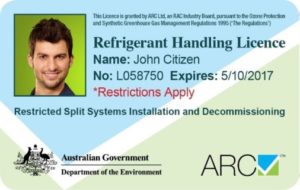
For split system installation specifically, a restricted licence is generally sufficient rather than a full licence. The qualification pathway is Certificate II in Split Air Conditioning and Heat Pump Systems (UEE20120), which is what most electricians moving into this work complete.
“I’m an apprentice. Can I work on systems before I’m qualified?”
Yes, under a trainee licence. A trainee refrigerant handling licence allows you to handle refrigerant while working toward your qualification, subject to supervision requirements. But you can’t simply work unlicensed on the basis that you’re still learning.
“My business buys refrigerant in cylinders. Is my handling licence enough?”
No. Individual handling licences and business-level authorisations are separate things.
To acquire, possess, store or dispose of refrigerant, the business generally needs a Refrigerant Trading Authorisation (RTA). To handle it, the individual technician needs a refrigerant handling licence. A one-person contracting business typically needs both: a licence in your name and an RTA in the business’s name.
If you’re a sole trader buying cylinders on your own account without an RTA, that’s a compliance gap worth closing.
For split system air conditioners, the charge calculation is room-size dependent — approximately 334 grams of R290 in a standard 20m² room at current Australian standards. An IEC proposal to increase this for systems with additional safety measures is not yet adopted in Australia as of mid-2026.
One thing you can’t do is retrofit an existing HFC system with a hydrocarbon substitute. The system hasn’t been designed or tested for flammability, the electrical components haven’t been assessed for ignition risk, and the charge hasn’t been evaluated against the space. This is explicitly prohibited under AS/NZS 5149.4 and the ARC Refrigerant Handling Code of Practice.
Licence types at a glance
| Licence/authorisation | Licence/authorisation Held by | What it covers | |
|---|---|---|---|
| Refrigerant Handling Licence (Full) | Individual | Handling refrigerant across air conditioning and refrigeration work, within the scope of the licence class held | |
| Refrigerant Handling Licence (Restricted) | Individual | A defined subset of work, such as split system installation and decommissioning, or automotive air conditioning | |
| Trainee Refrigerant Handling Licence (TRH) | Individual | Handling refrigerant while working toward a qualification, subject to supervision conditions | |
| Refrigerant Trading Authorisation (RTA) | Business | Acquiring, possessing, storing and disposing of refrigerant |
What Counts as "Handling" Refrigerant
This is where installers most often assume they’re outside the scheme when they aren’t. Under the Regulations, handling is defined broadly to cover:
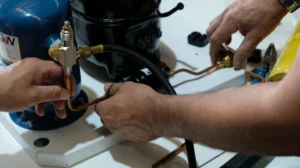
- Installing equipment where you connect or charge the refrigeration circuit
- Commissioning and charging a system
- Servicing, including topping up or adjusting a charge
- Leak testing that involves breaking into the circuit
- Recovering refrigerant
- Decommissioning or decanting equipment
- Disposing of recovered refrigerant
Essentially, if you break into the refrigeration circuit for any reason, you’re handling refrigerant.
Work that generally falls outside it includes electrical connection only, mounting brackets and physical positioning, and ductwork that doesn’t touch the refrigeration circuit. Installing a hermetically sealed appliance you never open, like a plug-in display fridge, for example, generally isn’t handling either.
Reporting and Recording Requirements
Australia doesn’t impose the routine mandatory leak-check-and-log regime that European operators work under. There’s no general schedule requiring periodic leak inspections by system charge size, and no equivalent equipment logbook mandated across the board for ordinary commercial AC and refrigeration.
What Australia does require is broadly:
- No venting: You must not discharge refrigerant to atmosphere, and you must take reasonable steps to prevent emissions during handling. This is the core obligation.
- Recovery: Refrigerant must be recovered rather than released when servicing or decommissioning.
- Record keeping by RTA holders: Businesses holding an RTA must keep records of refrigerant acquired, sold, recovered and disposed of, and produce them on request.
- Licence currency: Your licence must be current, and you must work within its scope.
Penalties: What Happens if You Get it Wrong
Breaches of Australia’s refrigerant laws can attract both criminal and civil penalties, depending on the offence.
From 1 July 2026, one Commonwealth penalty unit is worth $364.
For contractors, common breaches such as carrying out refrigerant handling work without the required licence, possessing bulk refrigerant without an RTA, or failing to keep required RTA records can attract penalties of up to 50 penalty units ($18,200) for a criminal offence or 60 penalty units ($21,840) as a civil penalty.
More serious breaches, including unlawfully releasing refrigerant to the atmosphere or importing scheduled substances without the required licence, can attract significantly higher penalties.
How Australia's Scheme Differs from European F-Gas Regulations
This is the confusion worth clearing up, because searching for refrigerant obligations returns mostly European material and the two schemes work differently.
“F-Gas” is not an Australian term. If a supplier, manufacturer or piece of software refers to F-Gas compliance requirements, that’s European documentation. Your obligations sit under the AGS Act and the ARCtick scheme, and they’re not interchangeable.
| Australia | European Union | ||
|---|---|---|---|
| Terminology | Synthetic greenhouse gas (SGG) / artificial greenhouse gas (AGS) | Fluorinated greenhouse gas ("F-Gas") | |
| Legislation | Ozone Protection and Synthetic Greenhouse Gas Management Act 1989 (Cth) | EU F-Gas Regulation | |
| Supply control | Import quota, stepped down biennially | Production and import quota, with broader placing-on-market bans | |
| Personal certification | ARCtick refrigerant handling licence | Member-state certification schemes | |
| Business authorisation | Refrigerant Trading Authorisation | Varies by member state |
Yes, in most cases. Your electrical licence covers the electrical work. Connecting the refrigeration circuit and releasing the pre-charged refrigerant is handling refrigerant, which requires a refrigerant handling licence.
The handling licence is held by you as an individual and authorises you to work with refrigerant. The RTA is held by the business and authorises acquiring, possessing and disposing of it. Most contracting businesses need both.
No. A2L refrigerants fall under the existing licence framework. Because they’re mildly flammable, training on handling, charge limits and safe work practices is strongly recommended, but the phase-down hasn’t created a new licence category.
Yes. ARCtick is a Commonwealth scheme administered nationally, so your licence is valid across Australia. Note that state-based electrical, plumbing and work health and safety obligations apply separately and independently.
Handling refrigerant with an expired licence is handling without a licence. ARC issues renewal notices, but the obligation to hold a current licence is yours.
Get your ARCtick Licence Sorted With Get Skilled
If you need to gain or upgrade a refrigerant handling licence, Get Skilled Training delivers the qualifications that get you there.
- UEE20120 Certificate II in Split Air Conditioning and Heat Pump Systems: The pathway to a restricted licence for split system installation and decommissioning.
- UEE32225 Certificate III in Air Conditioning and Refrigeration: The full trade qualification and pathway to a full refrigerant handling licence.
Not sure which one fits where you are? Get in touch with our team and we’ll help you work out what you’ll need.